How better financial education, lifetime investment solutions and greater market scale can improve household resilience and long-term outcomes.
Europe’s ambition to mobilise more household wealth for productive investment will be judged by whether it changes how people save and invest over time. At Waystone’s Annual Ireland Summit, the panel From Savers to Investors considered what is needed to translate the Savings and Investments Union (SIU), Ireland’s proposed Personal Investment Account (PIA)* and related national reforms into sustained participation. Policy can create the route, but people must also have the capacity, confidence and support to use it.
The potential scale of the PIA illustrates what is at stake. Five years after launch, PIAs could represent a €15–€25 billion market, supported by perhaps 700,000–1 million account holders.** This is ambitious but credible against approximately €175 billion currently held in Irish household deposits and Ireland’s relatively low starting level of direct capital-market participation.
The wider European opportunity explains the commercial interest. Reallocating an amount equivalent to 1% of Europe’s €39.5 trillion of household financial assets would represent €395 billion; repeating that amount annually for five years would approach €2 trillion before investment growth. This is an illustration, not a forecast: the asset base includes existing investments, so it is not a measure of untapped deposits or wholly new fund assets. Even a modest shift could support investment in distribution and delivery, spreading fixed costs and improving value.
That opportunity depends on five conditions for sustained participation, set out below. Responsibility is shared across government, regulators, employers, industry, advisers and individuals.
Share
Condition
What it means
Who enables it
Financial capacity
Income left after essential costs and debt, plus an accessible emergency buffer. Only genuinely long-term money should be invested.
Economic and social policy, employers and individuals; providers must use affordability and suitability safeguards.
Visibility
A joined-up view of deposits, investments, pensions, fees, risk and likely retirement income.
Providers, platforms, pension schemes, data initiatives and public digital infrastructure.
Simplicity and trust
Clear tax treatment, understandable choices, fair value and confidence that the product will work as described.
Government, regulators, product manufacturers, advisers and trusted distributors.
Behavioural design
Defaults, prompts and contribution journeys that make beneficial action easier and help people persist.
Policymakers and employers, together with the retail banks, asset managers, pension providers, investment platforms and advisers that design and deliver the customer experience.
Effective delivery
Reliable administration, transfers, tax, reporting, data, oversight and resilience across the product lifecycle.
Plan managers, administrators, platforms, asset managers and service providers, regulator.
The Irish, UK and Swedish models later in the article show how these conditions work in practice; German pension reform provides a complementary lifetime-savings example.
Why now?
First, households need greater resilience across longer and less certain lives. Emergency savings remain essential, but longevity, weaker pension replacement rates, rising care costs and pressure on public finances mean more households must also build assets for retirement. Policy should help people distinguish money needed now from money that can work over decades.
Second, investing is more accessible, but not yet normalised. ETFs, digital platforms, fractional investing and lower-cost technology have reduced barriers, yet participation remains concentrated and some first-time investors have favoured volatile digital assets over diversified, long-term portfolios. Access has improved faster than confidence and habit formation.
Third, greater need and easier access have not changed behaviour at scale. €10,000 left in a zero-interest deposit from 2005 to 2025 would still show €10,000, but at 2% average inflation its purchasing power would fall to about €6,700 in 2005 terms. At an illustrative 5% annual return, it could have grown to approximately €26,500 before fees, tax and inflation. Many households still value certainty, fear capital loss and do not see themselves as investors. Financial education should therefore be judged by whether it changes decisions and outcomes.
Small shifts can have a meaningful impact, particularly when sustained. For an individual, investing €100 a month creates a manageable habit. Over ten years, €12,000 of contributions could grow to approximately €15,500 at an illustrative 5% annual return, before fees, tax and inflation.
From accumulation to retirement income
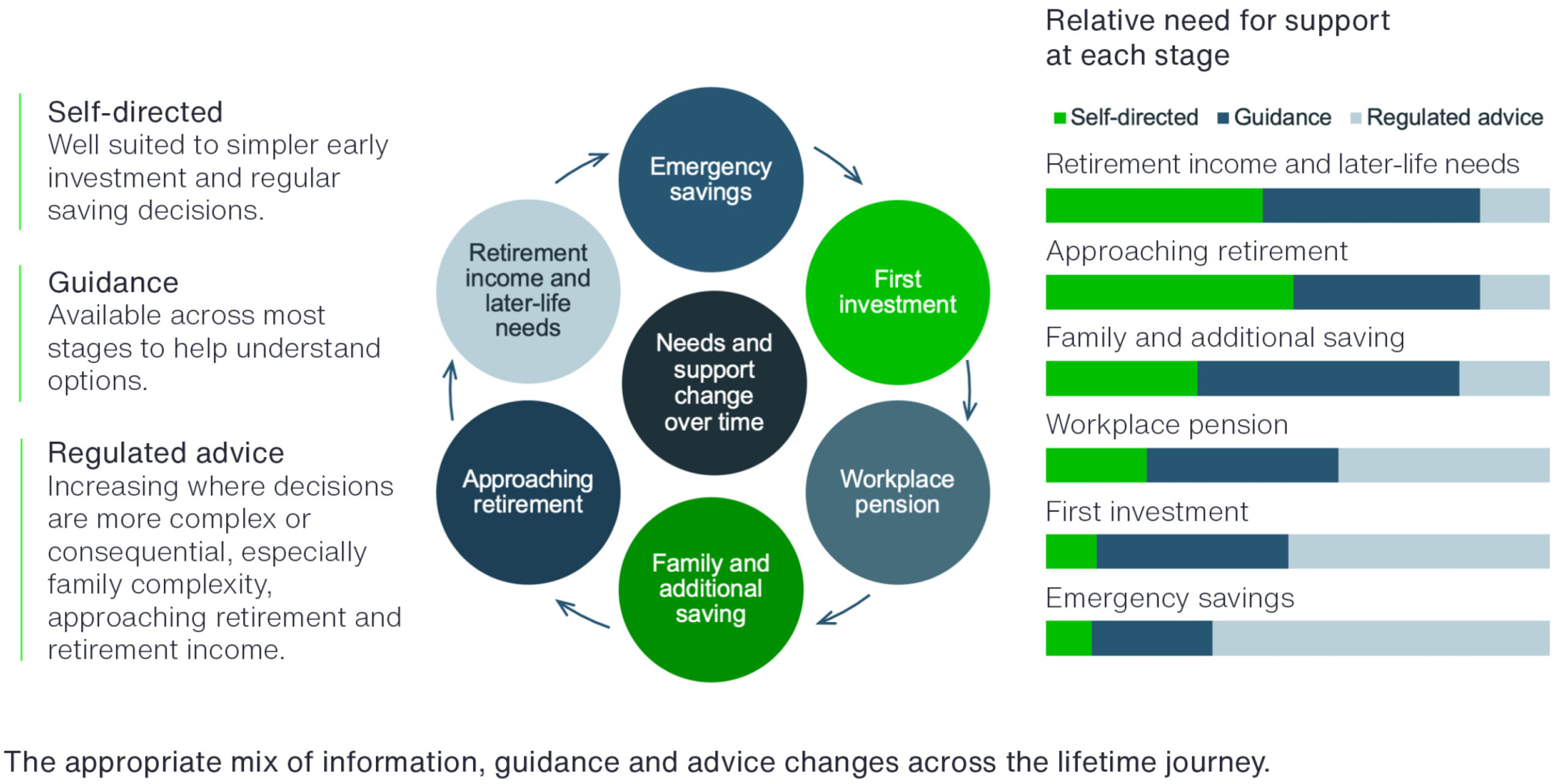
Participation must work across a lifetime rather than as a one-off product decision. Households move from building emergency savings and making a first investment through workplace pensions, additional retirement provision, decumulation and later-life care. The balance between liquidity, risk and return changes at each stage, as does the level of support required. People need to understand how pensions and personal investments combine, whether expected income is adequate and how accumulated assets can support a sustainable retirement.
The form of support should also change with the decision. Full regulated advice remains essential where choices are complex or consequential, particularly around retirement income and later-life needs, but it is neither necessary nor economic at every stage. Clear information, targeted support, digital guidance and appropriately scoped advice can broaden access, with escalation to full advice where the consequences justify it.
National culture also shapes participation. In Ireland, deposits, property and pensions have traditionally outweighed direct market investment. Sweden’s widely used investment accounts have made participation more familiar, while US workplace retirement plans and retail investing are more deeply embedded in household financial life. The PIA, auto-enrolment and SIU can create new routes, but trusted communication, sensible defaults and timely prompts are needed to make investing familiar without encouraging participation before households have the capacity.
What delivery requires
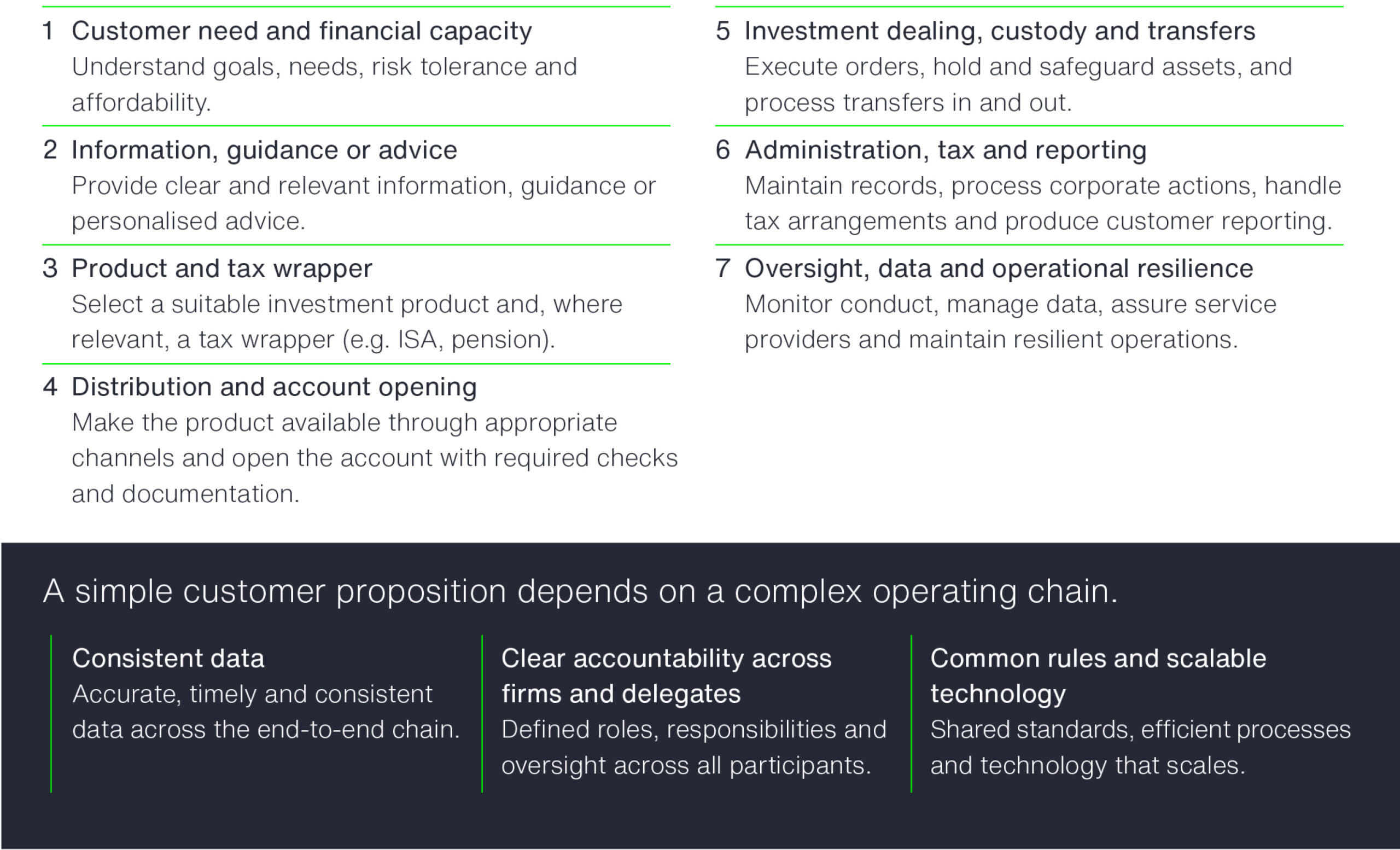
Turning savings-to-investment policy into sustained participation means building on established capabilities and connecting them around the retail investor. Ireland’s funds and ETF ecosystem provides a strong foundation for PIA offerings: Irish-domiciled fund assets reached €6.3 trillion at June 2026, up 14.5% in six months, with Ireland attracting 58% of European fund net inflows, while accounting for 72% of European-domiciled ETF assets. Funds and ETFs are likely to be important building blocks, offering accessible, potentially very low-cost diversification and broad asset-allocation choices suited to different preferences and risk appetites, through self-service or advised access. These product and servicing strengths provide a practical foundation for delivery. Waystone’s experience as a UK ISA Plan Manager reinforces how critical it is to understand the full retail delivery chain and its interdependencies, with every component in place, connected and operating effectively.
In practice, account providers, platforms, distributors, advisers and investment service providers must coordinate onboarding, asset eligibility, dealing, transfers, tax, records, communications and reporting. Reliable delivery depends on clear responsibilities and effective connections between these activities, underpinned by operational resilience and oversight of delegates and technology providers.
Cross-border consistency in tax, product rules, data, disclosures, transfers and supervision would allow firms to reuse technology and controls, rather than rebuild delivery market by market.
From investment building blocks to execution
Ireland’s funds base is therefore a starting point. Execution depends on how account rules, customer access and operational responsibilities fit together. The policy agenda is moving in that direction, but further development is still to come. National models offer practical lessons on connecting the investment proposition to participation, while showing where domestic solutions stop short of European scale.
The Irish PIA, UK ISA and Swedish Investment Savings Account (Investeringssparkonto or ISK) show how different choices on tax, simplicity and behavioural design affect participation. They also provide a practical test of whether national models can support efficient delivery and wider scale.
Germany’s planned private pension reforms provide a complementary lifetime-savings example. From 2027, the proposed Altersvorsorgedepot is expected to widen access to funds and ETFs, use contribution-linked state support and offer clearer retirement-income choices. It applies incentives, simplicity and persistence to pensions rather than flexible investment accounts; delivery remains untested.
Assessment
Irish PIA
UK ISA
Swedish ISK
Model and tax in brief
Flexible account; €12,000 annual limit. First €50,000 tax-free, then a 1% annual charge instead of exit tax and deemed disposal. Eligible assets include listed shares and bonds, regulated-market instruments, funds and ETFs; derivatives and crypto-assets are excluded.
Flexible wrapper; £20,000 annual allowance across ISA types. Interest, dividends and gains are tax-free within the wrapper. Depending on ISA type, eligible assets include cash, listed shares, bonds, funds, ETFs and certain innovative-finance assets.
Flexible account with no contribution ceiling. Annual tax is based on a formula value, not actual gains; the first 300,000 Swedish kronor (SEK) is tax-free in 2026. It can hold listed shares, funds, ETFs and other qualifying financial instruments.
Simplicity and trust
One limit and removal of exit tax/deemed disposal simplify the offer; the threshold and 1% charge still need explanation.
The tax-free outcome is familiar and clear; multiple ISA types and allowance rules add product-choice complexity.
No need to track individual gains or losses, simplifying reporting; tax can still arise when returns are weak.
Behavioural design
The tax-free threshold is a clear incentive; prompts, recurring contributions and trusted distribution are still needed to form habits.
A familiar tax-free benefit and regular saving tools support participation but opening and funding remain voluntary.
Simple annual tax, a tax-free threshold and digital access reduce friction; widespread use reinforces the social norm.
Current scale and delivery
New and untested. Success depends on participation, distribution and economical delivery at scale.
Mature and effective nationally but fragmented across ISA types and bounded by one market.
Works relatively well domestically but is not a platform for European scale.
From ambition to lasting change
SIU, Ireland’s proposed PIA, auto-enrolment and reforms elsewhere are creating practical routes into investment and retirement saving. The comparison shows that favourable tax treatment can encourage participation, but national success does not automatically create a scalable market. The priority is to combine the strongest features of these models with greater EU consistency and sufficient alignment with the UK.
The shift will take time: saving cultures, confidence and expectations develop over generations. It must also work commercially. Savers and investors need fair value and support through changing life stages; advisers need economical ways to reach more people; and providers need scale to invest in resilient delivery. Ireland’s PIA will test whether its international funds expertise can help build participation at home. The wider measure of success is better household resilience, stronger retirement outcomes and a durable investment culture.
To discuss the opportunities and practical implications of these developments for your business, and explore where Waystone can support, please get in touch with your usual Waystone contact.
* Under the Finance (No. 2) Bill 2026, PIA is referred to as Individual Investment Account.
** Illustrative five-year scenario assuming 700,000–1 million PIA accounts by mid-2032, with a mix of lower-contribution (€100–€200/month), core (€350–€500/month) and higher-contribution investors (up to the €12,000 annual allowance), some redirection of existing deposits, progressive account adoption and moderate investment growth. The €50,000 tax-free threshold is not treated as an account cap, as the proposed 1% annual tax applies only to value above the threshold.
*** Monthly investment illustration: assuming €100 invested at the end of each month and a constant 5% effective annual return, compounded monthly, contributions of €12,000 over ten years would grow to approximately €15,436 (rounded to €15,500 in the article). Over twenty years, contributions of €24,000 would grow to approximately €40,580. Contributions are invested progressively, rather than as a lump sum at the outset, so the average contribution in the ten-year example is invested for around five years. Figures are illustrative, before fees, tax and inflation, and are not forecasts. Actual returns will vary and capital is at risk.
Europe’s asset-backed securities (ABS) market continues to gather momentum. Investor demand is strengthening, issuance is recovering and private credit managers…
Institutional capital continues to flow into private real estate strategies, but investors now expect more than just performance. Governance, transparency,…
Directive (EU) 2024/927 (AIFMD 2.0) represents a meaningful evolution of Europe’s alternative investment and retail investment frameworks by amending the…
Despite volatile geopolitical and economic conditions, private credit continues to attract capital as investors seek yield stability and predictable cashflows.
The global asset management industry is undergoing a profound transformation, driven by structural shifts in distribution, product innovation, and investor…
Patricia O’Connor, Managing Director of Corporate Services at Waystone, shares her perspective on emerging trends in aviation capital markets, aircraft…
The Cayman Islands Department of International Tax Cooperation (DITC) has announced significant amendments to the Common Reporting Standard (CRS) Regulations.
The UK's Financial Conduct Authority (FCA) has introduced the Consumer Duty, setting higher standards for consumer protection across financial services.
As 2025 progresses, the evolving geopolitical landscape continues to bring uncertainty and instability, with intensifying trade wars, growing cyber threats,…
As the private equity industry continues to evolve, fund managers are facing mounting operational challenges. These include navigating more regulation,…
Geopolitical instability, shifting regulatory frameworks and macroeconomic uncertainty are no longer isolated events but continuous forces shaping global finance. For…
The past decade has been transformative for the asset management industry, marked by increasing regulatory requirements and operational complexities, heightened…
Building on the concepts outlined in Waystone’s earlier marketing piece, Operational Due Diligence and Independent Fund Directors: Collaborating for Success,…
In the complex world of investment management, the relationship between Operational Due Diligence (ODD) professionals and independent fund directors has…
Futureproofing asset management isn’t just about addressing current needs but ensuring that the infrastructure, technology and processes are adaptable to…