From regulatory pressure to strategic advantage: reassessing the management company operating model

Investment Managers are facing a convergence of regulatory, cost, technology and supervisory pressures that are changing the economics and resilience requirements of the operating model. A critical but sometimes overlooked component of that operating model are the European management companies and equivalent UK Authorised Corporate Directors (ACDs), which are undergoing a significant volume of regulatory change as well as greater regulatory scrutiny in multiple jurisdictions. The issue is no longer whether individual regulatory changes can be implemented; but rather their cumulative impact calls into question whether the management company operating model remains proportionate, scalable and strategically aligned.
The strategic question is where the firm should continue to own capability, where it should build or share capability, and where specialist partnerships may provide greater scale, resilience and focus. The answer will differ by business model, product complexity, jurisdictional footprint and growth trajectory, but the decision should be made deliberately rather than after cost, regulatory pressure or operational stress exposes fragility.
Investment Managers should not wait for regulatory change, growth or market stress to force an operating model response. They should reassess now, preserve focus on the activities that differentiate the business, and ensure that governance, data, oversight and resilience are delivered through a model capable of supporting future growth.
Why this matters now
When the volume and pace of regulatory change are high, there is a risk that strategic implications are not assessed early enough because each development is treated as a discrete compliance exercise.
For management companies, that strategic tipping point may be approaching. Management companies are facing a period of unprecedented regulatory transformation. With AIFMD II now live, UCITS Annex IV-type reporting on the horizon, the FCA proposals for the UK AIFM regime, and the European Commission’s MISP proposals introducing enhanced ESMA oversight and potential new obligations for large EU management company groups, firms must assess not only compliance impacts but also the implications for their operating models, governance frameworks, and distribution strategies.
Evolving expectations and sustained engagement with regulators including the CBI, CSSF, ESMA and FCA are also highly relevant. Together with the drive towards a more integrated EU capital market, including the Savings and Investments Union, these developments point to a more demanding operating environment. The speech by Deputy Governor McMunn, published alongside the Central Bank of Ireland’s Review of Delegation in the Irish Funds Sector Feedback Report on 23 July, illustrates the practical challenges firms now face.
Most Investment Managers will be affected by at least one of these challenges directly, and many will be affected by several, if not all. The challenge is to step back from the detail and ask what the cumulative impact means for the business strategy and related operating model, including management companies.
The strategic tipping point: when the model starts to work against the strategy
Operating models evolve in response to external factors and as firms grow in scale and complexity. The model that is proportionate and effective at one stage of growth may become inefficient, fragile or strategically limiting at another.
Value creation comes from focus and market differentiation. That focus can become diluted when firms grow in scale or complexity and begin building capabilities that are non-core but critical. Management time and resources get diverted toward maintaining infrastructure and governance rather than strengthening the activities that differentiate the business.
At a certain point, the cost and effort of maintaining internal capability can begin to outweigh the strategic benefit of owning it. The challenge is to identify that tipping point early: when it makes more sense to move into a different operating model, access specialist capability through a partner, or rebalance what is owned, shared or outsourced. The key is not outsourcing or partnering with a specialist provider for its own sake; it is aligning capability ownership with the firm’s strategy, risk profile and growth trajectory.
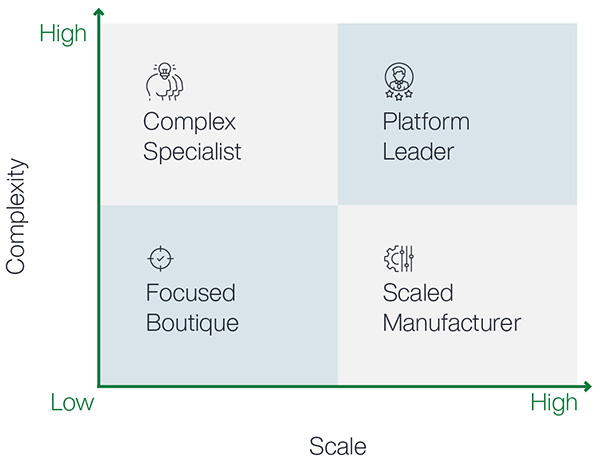
Business models evolve and so should the related management company operating model. Using four archetypes of management company (Focused Boutique, Scaled Manufacturer, Complex Specialist, Platform Leader), as set out further below, coupled with a practical diagnostic framework helps firms identify whether they are approaching a strategic tipping point: the point at which retaining all capability internally may dilute management focus, constrain growth or weaken resilience, while a more partner-enabled model may strengthen governance, oversight and flexibility.
Firms may move between these archetypes over time or operate a combination of them across different entities, products or jurisdictions.
Figure 1: Operating model archetypes
The same logic applies to regulatory and market developments that can change the operating model requirements for a management company. Examples include:
- ETF wrappers, private markets and wealth-channel expansion, which create new challenges around liquidity, valuation, operating ecosystems and counterparties, including Authorised Participants (APs);
- Retailisation and wealth-channel optimisation, which increase distribution complexity and heighten the need for appropriate product governance and oversight; and
- Transformative infrastructure, including tokenisation and artificial intelligence, which are significant operating model changes in their own right before firms even consider the regulatory expectations that are and will develop around them.
From archetype to assessment: testing whether the current model remains fit for purpose
If the firm’s archetype, growth plans and external pressures are no longer aligned, senior management should reassess what capability is retained, built, shared or accessed through partners.
Figure 2: Operating model assessment framework
| External forces | Strategic choices | Operating model factors |
|---|---|---|
| 1. Geopolitical risk 2. Technology capabilities 3. Increasing costs 4. Regulations & regulator scrutiny |
5. Investment strategy & related products 6. Target client profiles 7. Jurisdictions 8. Build, buy and/or partnership for capabilities |
9. People, process & controls 10. Technology systems 11. Data platforms & insight 12. Partnerships & vendors |
There are trade-offs to be made given resources are not finite. The relevance and response of management to external challenges vary depending on the firm’s archetype, strategy, product set, target clients, jurisdictions and existing capability base.
Using this framework coupled with the diagnostic questions enables you to identify whether pressure is building in specific parts of the model and whether capability should be retained, built, shared or accessed through partners.
It translates external factors, strategic choices and operating model capabilities into practical questions for senior management. Used alongside the archetypes in Figure 1, it helps firms assess whether their current model remains proportionate, scalable and strategically aligned, or whether they are approaching a strategic tipping point.
Diagnostic questions: where pressure is building in the model
Figure 3: Applying the framework — strategic diagnostic questions
| Assessment area | Diagnostic questions | Related Figure 2 factors |
|---|---|---|
| Strategy, focus and differentiation | Are senior resources focused on the investment strategies, products, clients and jurisdictions that drive business outcomes?
How much management time is spent on regulatory, governance and operational infrastructure rather than differentiation? Does the firm have the resources, scale and execution capacity to move quickly when launching new products, entering new markets or responding to sector-wide change? |
5, 6, 7, 8, 9 |
| Scale, cost and efficiency | How scalable is the operating model as AUM, product volume and regulatory expectations increase?
Are there capabilities that are duplicative or that already exist at scale within the group or through specialist providers? Are rising costs and oversight requirements being absorbed without sufficient economies of scale? |
3, 8, 9, 10, 12 |
| Capability depth and sustainability | Does the specialist expertise needed for growth exist across risk, compliance, governance and oversight?
Does the model attract, retain and develop the skills needed to support the firm’s product set and jurisdictions? Are people, process and control capabilities keeping pace with regulatory change and supervisory expectations? |
4, 7, 8, 9, 12 |
| Technology, data and infrastructure | Are technology systems, data platforms and management information sufficient to support effective oversight, reporting and challenge?
Can the infrastructure scale with increasing product complexity, AUM, reporting expectations and regulatory demand? Are we building and maintaining technology that is essential to operate but not a source of competitive advantage? |
2, 10, 11 |
| Governance, risk and resilience | Does the current model create concentration, dependency or conflict-of-interest risks across internal teams, delegates or vendors?
Is the oversight framework evolving in line with supervisory expectations on governance, delegation and operational resilience? Can the model absorb geopolitical, market, operational and regulatory stress without significant additional investment? |
1, 4, 9, 11, 12 |
| Strategic flexibility and growth | Is capital or management attention tied up in operational infrastructure rather than growth initiatives?
Does the model enable rapid entry into new products, markets or jurisdictions? Could a scalable or partner-enabled platform accelerate strategic objectives while strengthening governance, oversight and resilience? |
5, 6, 7, 8, 12 |
Where several answers indicate strain, duplication, lack of specialist depth or limited scalability, it is time to reassess the operating model choices available. That does not automatically mean moving to outsourcing. It should, however, prompt a structured review of what should be retained, built, shared or accessed through partners so that capability ownership remains aligned with strategy, risk appetite and growth plans.
Conclusion: reassess before pressure becomes constraint
Investment Managers should not wait for regulatory change, growth or market stress to expose weaknesses in their operating model. The more important question is whether there are already signs of strain: rising cost and complexity, increasing management time spent on governance and regulatory infrastructure, pressure on specialist capability, or difficulty scaling oversight, data and resilience.
When those signs of strain are viewed alongside the volume of regulatory change and the intensity of regulatory interaction now focused on management companies, the issue becomes more than operational efficiency. It becomes a strategic regulatory imperative: to assess whether the management company model within the wider Investment Manager operating model remains proportionate, scalable and aligned to the business strategy, or whether it should be changed to strengthen the business overall.
The objective is not simply to reduce burden or outsource activity. It is to play to the firm’s strengths: preserving management focus for the activities that differentiate the business, while ensuring that governance, oversight, data, resilience and regulatory engagement are delivered through a model capable of supporting future growth.
If you have any questions regarding the themes raised in this article, please contact your usual Waystone representative or our team via the button below. You can also find more insights from Waystone’s experts and join our mailing list on our News & Events page.