From regulatory pressure to strategic advantage: reassessing the management company operating model

      Executive summary: the operating model decision can no longer be deferred

      Investment Managers are facing a convergence of regulatory, cost, technology and supervisory pressures that are changing the economics and resilience requirements of the operating model.  A critical but sometimes overlooked component of that operating model are the European management companies and equivalent UK Authorised Corporate Directors (ACDs), which are undergoing a significant volume of regulatory change as well as greater regulatory scrutiny in multiple jurisdictions. The issue is no longer whether individual regulatory changes can be implemented; but rather their cumulative impact calls into question whether the management company operating model remains proportionate, scalable and strategically aligned.

      The strategic question is where the firm should continue to own capability, where it should build or share capability, and where specialist partnerships may provide greater scale, resilience and focus. The answer will differ by business model, product complexity, jurisdictional footprint and growth trajectory, but the decision should be made deliberately rather than after cost, regulatory pressure or operational stress exposes fragility.

      Investment Managers should not wait for regulatory change, growth or market stress to force an operating model response. They should reassess now, preserve focus on the activities that differentiate the business, and ensure that governance, data, oversight and resilience are delivered through a model capable of supporting future growth.

      Why this matters now

      When the volume and pace of regulatory change are high, there is a risk that strategic implications are not assessed early enough because each development is treated as a discrete compliance exercise.

      For management companies, that strategic tipping point may be approaching. Management companies are facing a period of unprecedented regulatory transformation. With AIFMD II now live, UCITS Annex IV-type reporting  on the horizon, the FCA proposals for the UK AIFM regime, and the European Commission’s MISP proposals introducing enhanced ESMA oversight and potential new obligations for large EU management company groups, firms must assess not only compliance impacts but also the implications for their operating models, governance frameworks, and distribution strategies.

      Evolving expectations and sustained engagement with regulators including the CBI, CSSF, ESMA and FCA are also highly relevant. Together with the drive towards a more integrated EU capital market, including the Savings and Investments Union, these developments point to a more demanding operating environment. The speech by Deputy Governor McMunn, published alongside the Central Bank of Ireland’s Review of Delegation in the Irish Funds Sector Feedback Report on 23 July, illustrates the practical challenges firms now face.

      Most Investment Managers will be affected by at least one of these challenges directly, and many will be affected by several, if not all. The challenge is to step back from the detail and ask what the cumulative impact means for the business strategy and related operating model, including management companies.

      The strategic tipping point: when the model starts to work against the strategy

      Operating models evolve in response to external factors and as firms grow in scale and complexity. The model that is proportionate and effective at one stage of growth may become inefficient, fragile or strategically limiting at another.

      Value creation comes from focus and market differentiation. That focus can become diluted when firms grow in scale or complexity and begin building capabilities that are non-core but critical. Management time and resources get diverted toward maintaining infrastructure and governance rather than strengthening the activities that differentiate the business.

      At a certain point, the cost and effort of maintaining internal capability can begin to outweigh the strategic benefit of owning it. The challenge is to identify that tipping point early: when it makes more sense to move into a different operating model, access specialist capability through a partner, or rebalance what is owned, shared or outsourced. The key is not outsourcing or partnering with a specialist provider for its own sake; it is aligning capability ownership with the firm’s strategy, risk profile and growth trajectory.

      Business models evolve and so should the related management company operating model. Using four archetypes of management company (Focused Boutique, Scaled Manufacturer, Complex Specialist, Platform Leader), as set out further below, coupled with a practical diagnostic framework helps firms identify whether they are approaching a strategic tipping point: the point at which retaining all capability internally may dilute management focus, constrain growth or weaken resilience, while a more partner-enabled model may strengthen governance, oversight and flexibility.

      Firms may move between these archetypes over time or operate a combination of them across different entities, products or jurisdictions.

      Figure 1: Operating model archetypes
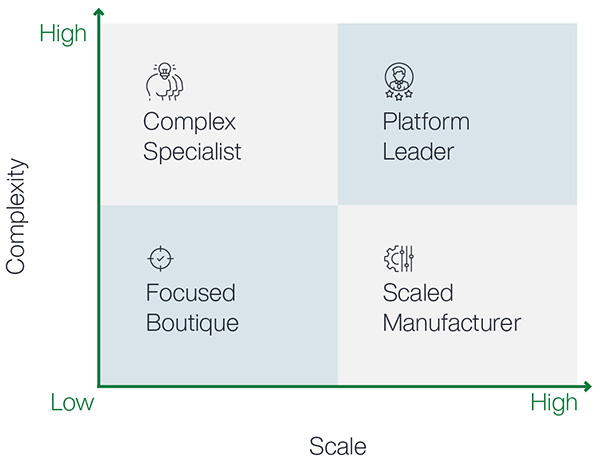
      Focused Boutique: lower scale of AUM and investment strategies. Typically, a lean in-house model with outsourcing and partnerships used proportionately. The main watch point is resilience: key-person dependency or limited specialist depth may become exposed in periods of stress.

      Scaled Manufacturer: higher scale with relatively standardised products. These firms may invest in centres of excellence, either internally or through outsourcing, to manage cost and consistency. The main watch point is whether growth creates excessive scale, rigidity or incremental complexity that the model was not designed to absorb.

      Complex Specialist: higher investment strategy complexity relative to scale, for example, private credit. Less standardised operations, products or investment strategies require deeper expertise and more tailored oversight. The main watch point is whether the firm is investing heavily in non-core but critical capabilities that do not directly drive differentiation.

      Platform Leader: larger volume of investment strategies, with a range of product complexity supported by an industrialised, partner-enabled operating model. The main watch point is governance over the ecosystem: ensuring clear accountability, effective challenge, data quality and resilience across internal and external capabilities.

      The same logic applies to regulatory and market developments that can change the operating model requirements for a management company. Examples include:

      • ETF wrappers, private markets and wealth-channel expansion, which create new challenges around liquidity, valuation, operating ecosystems and counterparties, including Authorised Participants (APs);
      • Retailisation and wealth-channel optimisation, which increase distribution complexity and heighten the need for appropriate product governance and oversight; and
      • Transformative infrastructure, including tokenisation and artificial intelligence, which are significant operating model changes in their own right before firms even consider the regulatory expectations that are and will develop around them.

      From archetype to assessment: testing whether the current model remains fit for purpose

      If the firm’s archetype, growth plans and external pressures are no longer aligned, senior management should reassess what capability is retained, built, shared or accessed through partners.

      Figure 2: Operating model assessment framework

      External forces Strategic choices Operating model factors
      1. Geopolitical risk
      2. Technology capabilities
      3. Increasing costs
      4. Regulations & regulator scrutiny
      5. Investment strategy & related products
      6. Target client profiles
      7. Jurisdictions
      8. Build, buy and/or partnership for capabilities
      9. People, process & controls
      10. Technology systems
      11. Data platforms & insight
      12. Partnerships & vendors

      There are trade-offs to be made given resources are not finite. The relevance and response of management to external challenges vary depending on the firm’s archetype, strategy, product set, target clients, jurisdictions and existing capability base.

      Using this framework coupled with the diagnostic questions enables you to identify whether pressure is building in specific parts of the model and whether capability should be retained, built, shared or accessed through partners.

      It translates external factors, strategic choices and operating model capabilities into practical questions for senior management. Used alongside the archetypes in Figure 1, it helps firms assess whether their current model remains proportionate, scalable and strategically aligned, or whether they are approaching a strategic tipping point.

      Diagnostic questions: where pressure is building in the model

      Figure 3: Applying the framework — strategic diagnostic questions

      Assessment area Diagnostic questions Related Figure 2 factors
      Strategy, focus and differentiation Are senior resources focused on the investment strategies, products, clients and jurisdictions that drive business outcomes?

      How much management time is spent on regulatory, governance and operational infrastructure rather than differentiation?

      Does the firm have the resources, scale and execution capacity to move quickly when launching new products, entering new markets or responding to sector-wide change?

      5, 6, 7, 8, 9
      Scale, cost and efficiency How scalable is the operating model as AUM, product volume and regulatory expectations increase?

      Are there capabilities that are duplicative or that already exist at scale within the group or through specialist providers?

      Are rising costs and oversight requirements being absorbed without sufficient economies of scale?

      3, 8, 9, 10, 12
      Capability depth and sustainability Does the specialist expertise needed for growth exist across risk, compliance, governance and oversight?

      Does the model attract, retain and develop the skills needed to support the firm’s product set and jurisdictions?

      Are people, process and control capabilities keeping pace with regulatory change and supervisory expectations?

      4, 7, 8, 9, 12
      Technology, data and infrastructure Are technology systems, data platforms and management information sufficient to support effective oversight, reporting and challenge?

      Can the infrastructure scale with increasing product complexity, AUM, reporting expectations and regulatory demand?

      Are we building and maintaining technology that is essential to operate but not a source of competitive advantage?

      2, 10, 11
      Governance, risk and resilience Does the current model create concentration, dependency or conflict-of-interest risks across internal teams, delegates or vendors?

      Is the oversight framework evolving in line with supervisory expectations on governance, delegation and operational resilience?

      Can the model absorb geopolitical, market, operational and regulatory stress without significant additional investment?

      1, 4, 9, 11, 12
      Strategic flexibility and growth Is capital or management attention tied up in operational infrastructure rather than growth initiatives?

      Does the model enable rapid entry into new products, markets or jurisdictions?

      Could a scalable or partner-enabled platform accelerate strategic objectives while strengthening governance, oversight and resilience?

      5, 6, 7, 8, 12

      Where several answers indicate strain, duplication, lack of specialist depth or limited scalability, it is time to reassess the operating model choices available. That does not automatically mean moving to outsourcing. It should, however, prompt a structured review of what should be retained, built, shared or accessed through partners so that capability ownership remains aligned with strategy, risk appetite and growth plans.

      Conclusion: reassess before pressure becomes constraint

      Investment Managers should not wait for regulatory change, growth or market stress to expose weaknesses in their operating model. The more important question is whether there are already signs of strain: rising cost and complexity, increasing management time spent on governance and regulatory infrastructure, pressure on specialist capability, or difficulty scaling oversight, data and resilience.

      When those signs of strain are viewed alongside the volume of regulatory change and the intensity of regulatory interaction now focused on management companies, the issue becomes more than operational efficiency. It becomes a strategic regulatory imperative: to assess whether the management company model within the wider Investment Manager operating model remains proportionate, scalable and aligned to the business strategy, or whether it should be changed to strengthen the business overall.

      The objective is not simply to reduce burden or outsource activity. It is to play to the firm’s strengths: preserving management focus for the activities that differentiate the business, while ensuring that governance, oversight, data, resilience and regulatory engagement are delivered through a model capable of supporting future growth.

      If you have any questions regarding the themes raised in this article, please contact your usual Waystone representative or our team via the button below. You can also find more insights from Waystone’s experts and join our mailing list on our News & Events page.

      Contact Us

      Share
       Next post

      More like this

      Europe’s ETF Horizon: How are our six ETF predictions for 2026 tracking at the mid-year mark?

      At the start of the year, Waystone made six bold predictions about where the European ETF market was heading in…
      Read more

      From regional market to global financial hub: Looking ahead to the Middle East's next twenty years

      This week, Waystone marks twenty years of operating in the UAE. It's an opportunity to reflect on how dramatically the…
      Read more

      Five Trends Reshaping Private Credit Platforms

      Private credit has established itself as one of the defining growth stories in alternatives. With assets under management expected to…
      Read more

      Why Scaling Private Credit Strategies Demands Greater Operational Control

      What began as an opportunistic strategy in the aftermath of the global financial crisis has evolved into a structurally significant…
      Read more

      Moving Beyond Self-Administration as Private Equity Platforms Scale

      For many private equity managers, self-administration is a natural starting point. In the early years, lean teams, simple fund structures…
      Read more

      Are European Portfolios Built for the New Global Economic Order?

      For years, portfolio construction has been shaped by a relatively stable set of assumptions: US equity outperformance, dollar dominance, low…
      Read more

      Private Markets 2.0 and the New Operating Model

      Private markets are entering a new phase where growth is no longer the challenge. Scaling with control is.
      Read more

      AIFMD 2.0: Strengthening Europe’s Investment Framework for Managers, Asset Owners and Investors

      Directive (EU) 2024/927 (AIFMD 2.0) represents a meaningful evolution of Europe’s alternative investment and retail investment frameworks by amending the…
      Read more

      Consumer Composite Investments (“CCI”) Reform: A New Era of Disclosure for UK Asset Managers

      The Financial Conduct Authority’s (“FCA”) Consumer Composite Investments (“CCI”) reform package marks one of the most significant shifts in retail…
      Read more

      How US Private Credit Fund Managers Can Strengthen Their Operating Model

      Despite volatile geopolitical and economic conditions, private credit continues to attract capital as investors seek yield stability and predictable cashflows.…
      Read more

      Asset Management in Transition: Key Trends Shaping 2026

      The global asset management industry is undergoing a profound transformation, driven by structural shifts in distribution, product innovation, and investor…
      Read more

      Emerging Trends in Aviation Capital Markets

      Patricia O’Connor, Managing Director of Corporate Services at Waystone, shares her perspective on emerging trends in aviation capital markets, aircraft…
      Read more

      Co-Sourcing in Hedge Fund Administration: Considerations, Challenges and Opportunities

      As hedge funds navigate an increasingly complex operational landscape, the question of how to structure fund administration has never been…
      Read more

      How to Successfully Distribute ETFs in Switzerland

      Drawing on Waystone’s deep ETF experience, our Switzerland ETF distribution guide aims to assist issuers navigate one of Europe’s most…
      Read more

      Europe’s ETF Horizon:
      Our 6 Predictions for 2026

      Europe’s ETF market is entering a new phase of growth and evolution. With record inflows, accelerating product innovation, and regulatory…
      Read more

      Trading Up: Why Hedge Fund Managers are Transforming Their Fund Administration

      The third quarter of 2025 saw the global hedge fund industry post record growth for the eighth consecutive quarter, with…
      Read more

      Data at the Core: How Emerging Asset Classes Are Reshaping Fund Administration

      Alternative asset management sits in a wide spectrum of investment infrastructure, from private equity, hedge funds and real estate to…
      Read more

      Forces Reshaping Fund Administration in 2026

      2025 was a year of regulatory pressure, unpredictable geopolitics, shifting interest-rate dynamics and accelerating investor expectations. Fund managers faced tightening…
      Read more

      Next-Generation Hedge Fund Administration in 2025 and Beyond

      In a market where global hedge fund capital reached a record of almost $5 trillion in Q3 2025, fund administration…
      Read more

      Cayman Islands CRS Amendments: Key Changes

      The Cayman Islands Department of International Tax Cooperation (DITC) has announced significant amendments to the Common Reporting Standard (CRS) Regulations.
      Read more

      Free Zone or Onshore? Making the Right Choice for Fund Distribution in the UAE

      The United Arab Emirates (UAE) continues to position itself as a gateway to the Middle East for global fund managers…
      Read more

      The ETF Revolution: ETFs and the Next Chapter for Ireland

      The global Exchange Traded Funds (ETF) market has moved well beyond its origins as a simple index-tracking tool. Today, ETFs…
      Read more

      Enhancing Family Offices Through Governance and Operational Oversight

      Family offices have a long history in the financial sector and continue to evolve beyond fundamental wealth management.
      Read more

      Valuation Pressures in Luxembourg’s Private Markets: Getting It Right in a Higher-Rate Environment

      As USD interest rates remain elevated and liquidity conditions tighten, valuation practices across private markets in Luxembourg are under scrutiny.
      Read more

      Scaling with Confidence: A Fund Administration Roadmap for Private Equity Managers

      As a private equity firm evolves, the operational demands multiply. What begins as a tightly managed, founder-led process can quickly…
      Read more

      Launching an ELTIF: How U.S. fund managers can access the EU market through a Third Party AIFM

      As U.S. fund managers seek to expand into Europe, the European Long Term Investment Fund (ELTIF) offers a unique gateway…
      Read more

      Governance Matters in Evergreen Funds: The Role of the Independent Director

      Private markets have seen a notable rise in the popularity of evergreen fund structures in recent years driven by the…
      Read more

      How AI and Data Centres are Reshaping Real Asset Investing in the UK

      Data centres are rapidly moving to the forefront of infrastructure needs, powering the AI revolution but also driving electricity demand…
      Read more

      Beyond Compliance: The Role of Transfer Agents in Addressing Vulnerability Under UK Consumer Duty

      The UK's Financial Conduct Authority (FCA) has introduced the Consumer Duty, setting higher standards for consumer protection across financial services.
      Read more

      Distribution in the UAE: A Long-Term Strategy that Delivers

      In this Q&A, Selma Coffey, Head of Distribution Solutions at Waystone, outlines why lasting success in the UAE begins with…
      Read more

      The Digital Evolution of Investor Engagement: Why Transfer Agencies Matter More Than Ever

      The current generational wealth transfer is reshaping the world of investment. An estimated $68 trillion will pass from Baby Boomers…
      Read more

      The Cayman Islands: Delivering at the Highest Standards

      Waystone’s Country Head of the Cayman Islands, Alaina Danley, recently contributed a piece to The Alternative Investor, where she explores…
      Read more

      The Role of Independent Directors in the Digital Assets Industry for Cayman Investment Funds

      The Cayman Islands has long been a premier jurisdiction for investment funds, recognized for its robust regulatory framework and flexible…
      Read more

      Navigating Geopolitical Uncertainty: Evolving Financial Crime Risk Assessments

      As 2025 progresses, the evolving geopolitical landscape continues to bring uncertainty and instability, with intensifying trade wars, growing cyber threats,…
      Read more

      Real Estate Funds: Achieving Operational Excellence with Outsourcing

      The growing demands of investors and regulators continues to drive real estate managers to produce greater returns while maintaining larger…
      Read more

      Private Equity: Scaling and Simplifying Complex Operations with Outsourced Administration

      As the private equity industry continues to evolve, fund managers are facing mounting operational challenges. These include navigating more regulation,…
      Read more

      Risk in the Geopolitical Landscape: How Fund Administrators Proactively Support Fund Managers

      Geopolitical instability, shifting regulatory frameworks and macroeconomic uncertainty are no longer isolated events but continuous forces shaping global finance. For…
      Read more

      Cayman Islands Update – Q1 2025

      Welcome to our Cayman update which will provide you with a quarterly review of a wide range of Cayman Islands…
      Read more

      Hedge Funds:
      Streamlining Operations and Ensuring Compliance with Outsourced Administration

      Outsourcing hedge fund administration is a strategic solution for fund managers to achieving greater scale, faster time to market and…
      Read more

      Opportunities in the UAE for Global Fund Managers:
      Market Access and Benefits of an Independent Management Company

      The United Arab Emirates (UAE) has emerged as a vibrant and rapidly growing international financial centre, offering a wealth of…
      Read more

      CIMA’s Corporate Governance Update: Enhancing Oversight in Investment Funds

      On 14 April 2023, the Cayman Islands Monetary Authority (“CIMA”) issued the Statement of Guidance on Corporate Governance for Mutual…
      Read more

      Five Trends Driving the Growing Shift to Outsourcing Administration

      The past decade has been transformative for the asset management industry, marked by increasing regulatory requirements and operational complexities, heightened…
      Read more

      Operational Due Diligence and Independent Fund Directors: Working Together to Broaden Expertise and Advance Industry Standards

      Building on the concepts outlined in Waystone’s earlier marketing piece, Operational Due Diligence and Independent Fund Directors: Collaborating for Success,…
      Read more

      2025 Outlook: Evolving Models and Strategies in Asset Management

      In 2024, the asset management industry experienced significant growth, with global assets under management (AUM) reaching a record $132 trillion…
      Read more

      Private Credit Valuations and Retail Investors: Key Trends for 2025

      The Private Credit market is poised for significant growth as we approach 2025, driven by evolving regulatory frameworks, technological advancements…
      Read more

      Waystone ETF roundtable: A practical guide to building an ETF business

      The unique appeal of Exchange Traded Funds (ETFs), which combine the trading flexibility of stocks with the diversified holdings of…
      Read more

      As funds grow in complexity, outsourcing fund administration takes centre stage

      As funds evolve with increasing complexity, fund managers are increasingly turning to third-party specialists for essential support.
      Read more

      Waystone tops independent ManCo/AIFM rankings in the UK

      Waystone, a leading provider of specialist services to the global asset management industry, has been named as the largest independent…
      Read more

      Essential Strategies for Secure Administration: Proactively Managing Risk

      As administration becomes more complex and regulatory landscapes more demanding, fund managers must adopt a proactive approach to risk management.
      Read more

      Operational Due Diligence and Independent Fund Directors: Collaborating for Success

      In the complex world of investment management, the relationship between Operational Due Diligence (ODD) professionals and independent fund directors has…
      Read more

      Entering the European ETF Market: Key Considerations and Steps

      Exchange-Traded Funds (ETFs) have emerged as versatile and popular investment vehicles, offering exposure to a wide range of asset classes,…
      Read more

      Futureproofing asset management: Key strategies to succeed

      Futureproofing asset management isn’t just about addressing current needs but ensuring that the infrastructure, technology and processes are adaptable to…
      Read more

      Frequently Asked Questions about ETFs

      Exchange-Traded Funds (ETFs) have evolved far beyond their initial role as passive investment vehicles. Today, they are dynamic wrappers that…
      Read more

      Overcoming Valuation Obstacles in Private Equity and Private Credit

      In the complex landscape of private equity and private credit, valuation remains a challenging and often contentious topic.
      Read more

      A perfect storm for alternative lending

      Waystone’s Director, Client Solutions, Eamon Lyons, was recently featured in Spotlight Credit Funds Magazine, where he provided insight into how…
      Read more

      Renewable energy insights: Growing investor interest and opportunities

      Waystone’s director of ESG, Rebecca Palmer, was recently featured in Net Zero Investor where she provided insight into what to…
      Read more

      Global ESG regulatory summary and outlook for 2023

      At Waystone, we pride ourselves on being the world’s leading risk, governance and compliance firm, supporting managers with over $2Tn…
      Read more

      Insight into how corporate lobbying is coming under greater pressure

      Waystone’s director of ESG, Rebecca Palmer, was recently featured in Net Zero Investor where she provided insight into how corporate…
      Read more

      Waystone enters white-label ETF market in Europe with heavyweight hires

      Waystone’s Paul Heffernan (CEO) and Henry Glynn (Head of ETF Capital Markets & Distribution) were recently featured in an ETF…
      Read more

      Navigating the ever-evolving ESG landscape

      Waystone Independent Director, Rebecca Palmer, was recently featured in Deloitte's Performance Magazine, where she examines ESG trends:
      Read more

      Pandemic increases importance of leasing channel for airlines

      Waystone’s Managing Director, Andy Murphy, was recently featured in an Irish Times Special Report that discusses the benefits of leasing…
      Read more
      Read more

      EU Moves to create a lingua franca for investment in sustainable activities

      Waystone’s Executive Director, Vanora Madigan, was recently featured in the Irish Times Special Report, where she provided insight into EU…
      Read more
      Read more

      The end of greenwashing: Eco-friendly investing gets real

      Waystone’s Managing Director, Andy Murphy, was recently featured in an Irish Times Special Report about the growing popularity of ESG…
      Read more
      Read more

      The new UK Long Term Asset Fund (LTAF) – policy statement and supporting rules now in place

      On 7 May 2021, the Financial Conduct Authority (FCA), unveiled plans to create a new regime with the specific aim…
      Read more

      Dubai continues to demonstrate its commitment to global investors

      Are you considering setting up in the DIFC or ADGM?
      Read more

      All things being equal - featuring Laura O'Connell, Global Head of HR

      Are equal opportunity polices getting left behind due to coronavirus?
      Read more

      Managers turn a blind eye to role of tech emissions in climate crisis

      Managers are responsible for digital emissions related to their operations, employees working remotely and portfolios.
      Read more

      Waystone's global ManCo solutions - a significant differentiator in the market

      Hedgeweek: From pole to pole: Super ManCo Waystone offers global support
      Read more

      50 Leading Women in Hedge Funds 2021

      Alaina Danley and Selma Coffey are featured in the Hedge Fund Journal's 50 Leading Women in Hedge Funds 2021.
      Read more

      A new wave of sustainability reporting

      Investors and consumers will be able to assess sustainability and climate credentials
      Read more

      Investors are expressing a strong appetite for green bonds

      Green bonds may not deliver as high a return initially, but tax breaks and other incentives can make up the…
      Read more

      Market looks more and more to sustainable financing

      Jason Poonoosamy featured in the The Irish Times special report on sustainable financing and the impact of disclosure regulations. #esg…
      Read more

      Waystone veille au respect des règles

      En réponse à divers scandales financiers, les régulateurs mondiaux œuvrent sans relâche pour renforcer le cadre réglementaire de l’industrie. Leur…
      Read more

      Paperjam ALFI: Waystone - bringing certainty to your distribution

      Selma Coffey speaks on the Cross-Border Distribution Framework (CBDF) as it is the result of discussions that began in the…
      Read more

      Vanora Madigan and Paddy Governey speak to HedgeWeek on SFDR sustainability framework

      Vanora and Paddy speak on the EU's sustainability framework and how it remains a "work in progress" for many fund…
      Read more

      HedgeWeek Special Report: Fund domicile opportunities and the evolution of the third party management company sector

      In this special report senior executives at Waystone, a provider of institutional governance, risk and compliance services to the asset…
      Read more

      Waystone engagement with the new UK Long-Term Asset Fund (LTAF)

      On 7 May 2021, the Financial Conduct Authority (FCA), unveiled plans to create a new regime with the specific aim…
      Read more

      Welcome to Waystone

      Cyril Delamare, Waystone’s CGO, discusses the merger between Montlake, DMS, and MDO
      Read more

      Waystone: A Third-Party ManCo for Today

      The third-party ManCo market is booming but Global CEO Derek Delaney (pictured) and Marketing Director Alison Mitsas explain what it…
      Read more

      Merger of leading governance firms provides certainty in a rapidly changing world

      Waystone, a merger of DMS, Montlake and MDO, is the global leading provider of institutional governance, risk and compliance services…
      Read more

      Waystone: Supporting Asset Managers

      Way stones were once used to make compass magnets to guide mariners in the 1500s. Today, Waystone helps asset managers…
      Read more
      Contact us