SPACs: The Past, Present and Future
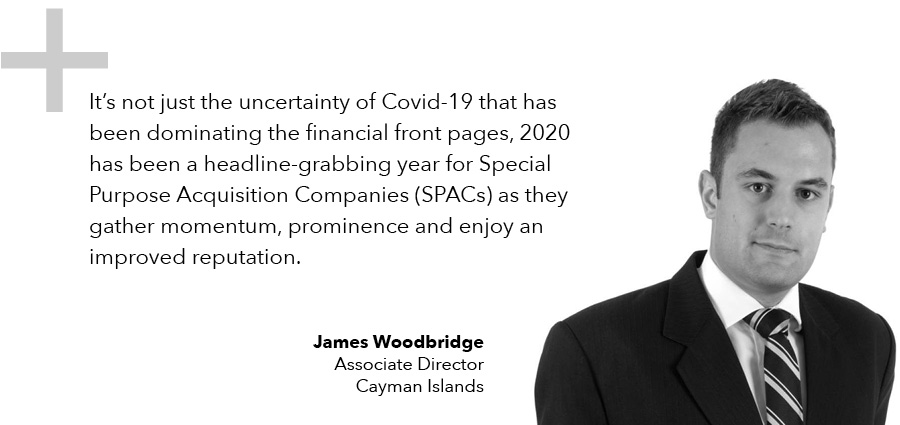
James Woodbridge, Associate Director based in our Cayman office, and part of our Fund Governance Team, updates us on the history of SPACs and how they have evolved over the years and their positioning for the future.
SPACs: A brief history
Often referred to as “blank cheque” companies, this unusual name derives from the fact that, after holding their own IPO, the publicly traded shell companies use their capital to buy-up unknown private companies (normally within a set timeframe). Thus a “reverse merger” is completed as the private target company becomes a public company and the arduous IPO process is bypassed.
The SPAC format has been around for over 30 years but 2020 has proved to be a bumper year with approximately $59billion raised in SPAC IPOs so far (for reference, $13.6billion was raised the previous year)1. It’s not just SPAC IPOs that are rising – so too is the average size of the IPO.
The waning SPAC from the 1990’s and 2000’s has undergone a renaissance and it’s not just good marketing. Since that time, the SEC has tightened regulations and procedures for these ventures, regulations have become stricter and investor protection has improved a great deal.
Other key factors have also played a big part in the stratospheric rise of the SPAC; an improvement in overall perception with high-profile companies, such as Richard Branson’s Virgin Galactic, choosing to raise capital through a SPAC rather than an IPO. Similarly, hedge fund veteran Bill Ackman (Pershing Square Capital Management) and Billy Beane (baseball executive and “Moneyball” subject) have further enhanced the vehicle’s reputation by setting up their own SPACs, to much fanfare.
Covid-19 has also played its part; the pre-IPO investor roadshows, where the private company’s executives would perform a series of presentations, are simply not possible at the moment. Conversely, as the SPAC has already raised its capital, the roadshow is rendered unnecessary.
SPACs vs IPOs
While the traditional IPO continues to have its place, with a SPAC, the capital raising process is quicker and less cumbersome, leaving behind the accompanying rigmarole of roadshows and high fees from investment banks.
As with other private equity investments, it is the ability of the SPAC’s management team to target and acquire a quality and/or undervalued company that will better safeguard a shareholder’s investment and provide a satisfactory return. It is worth remembering that, with the IPO reversal, there is no business to assess and therefore the investment decision can be made based on the management team behind the SPAC.
This has led to an increase of seasoned fund managers entering the space and acting as the sponsor of their own SPACs. These firms can leverage their experienced teams and credible track records to attract current and new investors. It is also not insignificant that these teams contain the necessary experience to be able to work with governance and on the management of the post-merger company to help minimize disruption.
What are the drawbacks of opting for a SPAC?
In terms of performance, returns can be mixed. In a recent report from Goldman Sachs, an assessment of 56 SPAC transactions over the last two years, showed that the SPACs typically outperformed the market in the first month and quarter, however thereafter the variations in returns were extremely wide.
Experienced investors will, however, be able to use their industry expertise to back the most skilled sponsors, those that are likely to have the highest probability of success.
What is the future for SPACs?
As traditional funds participate, institutional investor expectations are heightened, industry regulations are put in place, such as the implementation of independent oversight within the fund structure. This provides investors with the comfort that an independent director/advisory committee has been appointed with responsibility to manage potential conflicts of interest and ensure a corporate governance and compliance framework is in place and allows the sponsor management team to focus on the all-important task of identifying and investing in target companies.
So, what is the outlook for 2020 and beyond? The formation and successful SPAC IPOs this year indicate that there is plenty of capital ready to be deployed and we can expect significant mergers to be announced over the next couple of years. SPACs will certainly continue to be an important capital raising vehicle but key to their success and endurance must lie in avoiding the FOMO of the dotcom bubble and the ability to retain a healthy skepticism.
If you would like to discuss this topic in further detail or learn more how DMS can assist you with your fund requirements, please contact James Woodbridge or your usual DMS representative.